
Opening hours for 5,317 stations
Including which sites are genuinely 24/7, because the cheapest servo is worth nothing if it's shut when you get there.
Why Petrol Australia
Where every number comes from, what we add to it, and how the app is built and tested. Every figure on this page is a real count from our live systems, not a marketing estimate.
8,376
Service stations tracked
8 of 8
States and territories covered
9
Fuel grades priced, from Unleaded 91 to E85
33
Automated jobs keeping the data fresh
2,639
Automated tests that must pass before anything ships
5,317
Stations with opening hours, refreshed automatically
Beyond the feed
That's where most fuel apps stop too, because that's where the free data stops. We run 33 scheduled jobs to build a second layer on top, pulled from eight separate retailer sources.
1 / 3
Straight from the source
We don't guess prices, we don't infer them from nearby stations, and we don't buy them from a third-party aggregator.
1 / 8
Feeds update on their own schedules, and every station in the app shows when its price was last refreshed so you can judge how current it is. One thing no app can change: the board at the pump is always the final price. Check it before you fill.
With or without an account
An account is free, and it's what lets us store the things that are specific to you: your favourites, your alerts, your vehicles.
Open the app and go
Everything above, plus
On price: the app is free today. The first 1,000 sign-ups are on us, and after that we may need to introduce a fee. This app and the live price data behind it cost money to run, and we'd rather say that plainly now than surprise you later.
Nine gates
The specification is the source of truth, not the prompt and not the code. The test comes first and fails first. Passing tests are the definition of done, so generated code has to earn its way in rather than be taken on trust.
1 / 9
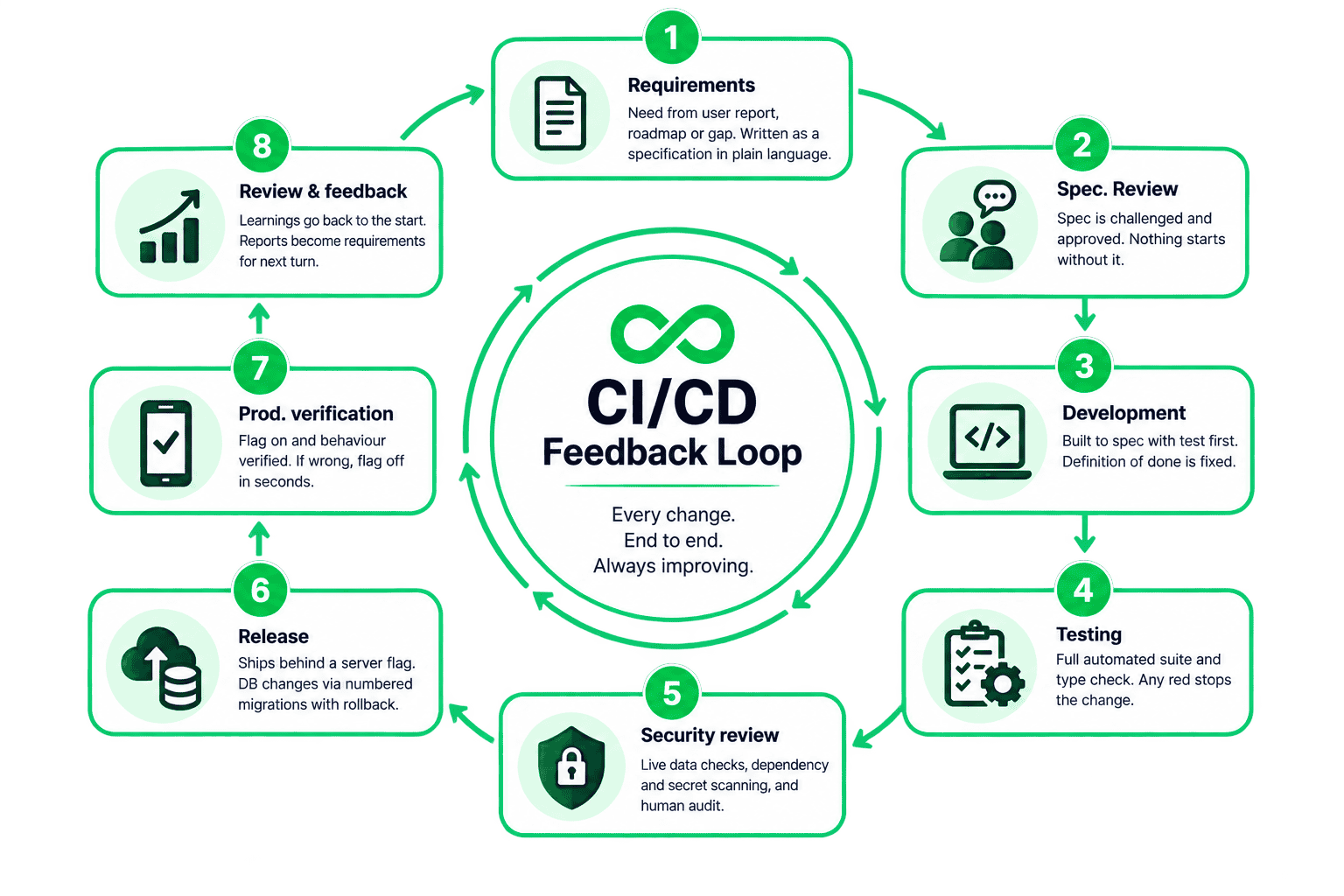
The loop
Those gates aren't a one-off checklist. They sit inside a loop that every change, from a one-line fix to a whole new feature, has to travel end to end.
What we don't do
If you spot something wrong, whether it's a price, the hours, or a station that's closed, report it from inside the app. No account needed.
1 / 5
Straight answers
The ones we'd rather answer here than have you wonder about.
Yes. AI was used to write code, and we don't shy away from that. We'd rather be upfront and honest about it than have you wonder.
What we'd rather talk about is what that code had to survive before it reached your phone: a written specification approved before anything was built, a failing test written before every fix, 2,639 automated tests and a strict type check that must pass, a numbered and reversible migration for every database change, security policies proven against the live database, and a server-side switch on every feature so it can be turned off in seconds.
So judge us on that bar rather than on who or what typed the code. A tool that writes code faster doesn't lower the bar. It just means more gets built against it.
“Vibecoding” means accepting generated code without reading it, testing it, or understanding it.
Here's what that method cannot produce. 150+ numbered database migrations, each with a verification query and a rollback script, logged in order. 33 server-side functions with their own test suites. Row-level security policies proven against production, table by table. Native home-screen widgets for both iOS and Android, and a CarPlay app written in Swift. 31 written feature specifications. An audit checklist that grows every time human judgement catches something the tests missed.
None of that survives a process without gates. Judge the result by the app.
The government feeds are where the prices come from, and we say so plainly: eight of them, one per state and territory. Every serious fuel app in Australia uses them, and any app claiming otherwise is worth a second look.
They're also where most apps stop. A government feed won't tell you whether a station is open at 11pm, whether it sells AdBlue, what its phone number is, or what your RAA membership actually takes off the price at that specific site. That layer is ours to build, and it's 33 scheduled jobs deep: opening hours for 5,317 stations, phone numbers for 2,495, AdBlue availability, and six motoring-club discount programs applied as real cents per litre.
We don't sell it, and we don't run ads.
Usage analytics are pseudonymous: at most a random account identifier, never your email, your name, your precise location, or anything you type. There's no session recording, and nothing is captured automatically. Events come from a fixed list written into the code, not a blanket record of every tap. You can turn analytics off in Preferences, and you can do that without an account, because a privacy control that requires signing up isn't a privacy control.
Everything stored against your account sits behind row-level security policies that we test against the live database to prove one account cannot read another's. You can delete your account and your data from inside the app.
Compare live petrol prices near you, pick the cheapest station, and save on every fill-up.